Showing posts with label BUSINESS. Show all posts

Friday, 15 October 2010

Quality of Life Improvement 29: Anatomy of a Tulip (2010)


The closest that we've ever come to affection for corporate America came in the early-1990s, courtesy of (yes, shockingly, we know) United Airlines.

Hong Kong's airport was still the storied Kai Tak (啟德機場) in those long-gone days. The airport's single runway had been carefully inserted on a tiny sliver of land between Hong Kong's mountains and harbor. Owing to the surrounding topography, pilots landing at Kai Tak would descend over Hong Kong, Victoria Harbour and Western Kowloon, passing over the beacon on Lion Rock while executing a tricky, tight 47° final turn, at low altitude, to (hopefully) line up with the airport's runway.


photo © Phil Wells

For any lucky enough to remember, the sight was spectacular—particularly on days with low cloud clogging the mountains. On those days, the scream of engines would be heard, but nothing would be seen. Then, almost instantaneously a 747 would emerge from the murk in a steep bank.

We remember a searing, sappingly hot and humid day in the summer of 1994. While absorbed in some forgotten banality, we heard the familiar sound of approaching engines, and looked around for the horizon, but saw nothing but block after grimy block of flats. Resigned to seeing nothing but laundry fluttering from open windows, we looked upwards again when the sound of the approaching aircraft became even louder and more piercing.


Then there, through the whites hanging on lines, was a United Airlines 747. For a short second after seeing that flash of red, white and blue, something felt familiar. It was as though we had seen a handsome, familiar face among the rows of hanging ducks that lined the streets of Hong Kong. Maybe we heard the last few bars of Rhapsody in Blue and thought of the shiny, muscular United States. Maybe we saw the image that we've seen dozens of times before over the past quarter-century: Diamond Head framed by United Airlines Tulip-emplazoned tails at Honolulu Airport. It reminded us of what's probably the love of our life—Hawaiʻi—and it made us smile.


Many things about that experience we vividly remember, but more than any, we remember the brilliant white tail emblazoned with the familiar United "Tulip," the sylized capital "U" logo created by American design legend Saul Bass for the airline in 1974.


Saul Bass is an American hero, a jack-of-all-design-trades. Beyond United Airlines, he designed now-iconic logos for AT&T, the Girl Scouts, Kleenex, Quaker, United Way, Warner Music Group and, ironically, Continental Airlines' "meatball" logo (1968-1991).


Bass is also known for his contribution to the cinematic arts. In particular, he created famous opening title credit sequences for famous films "The Man with the Golden Arm (1955)," "Vertigo (1958)," "Anatomy of a Murder (1958, with Duke Ellington, no less)," "North by Northwest (1959)" and "West Side Story (1961)," among many others.


Now, decades later and after many crises, United has recently merged with Continental Airlines. To be fair, over the last decade the airline industry has seen rocky, sometimes downright grim days, but the United "leadership" have never lost an opportunity to demonstrate their incompetence and venality.

Don't want to figure out how to pay for your employees' pensions, after you and your predecessors have frittered away their retirement money with foolish, risky investments instead of traditional, conservative investment in the bond market? No problem when you're a member of United's corporate leadership; The answers are simple if you're a CEO at United: fuck 'em with a closet-stick!

Forget the pensions. Forget the pensioners. Blame the unions (since, clearly, they're the ones ruining the United States), but keep your own incomes at vulgar levels. To give just one example, in 2006, United CEO Glenn Tilton's compensation was nearly $40 million. That's right. Forty. At the same time, United employees received generous lessons in the "cyclical nature" of "free markets," and other fantasies.

So by comparison, something like the deletion of a much-loved logo is actually quite minor.

Trivial, really.

That being said, the leadership of the new corporation created when United and Continental merged have decided to keep the United brand—a smart move—but have elected to delete United's iconic tulip in favor of Continental's...mirrorball...or globe...er, something...(?).

Almost immediately after the announcement, an outcrying of lament began among those who consider the Tulip part of the US' patrimony, along with the flag and Dolly Parton. Facebook pages sprang up; Online petitions began to circulate; Blogs, like this one, commented angrily about the asinine decision, but it all seems to have fallen on deaf ears at United.

From a commercial perspective, it beggars belief that Continental's bland, unidentifiable logo would be chosen as the emblem of one of the United States' most visible brands. Why quit a logo with longstanding, widespread popular recognition for one that almost no one can conjure from memory on command? It doesn't seem sensible, even by the already low standards of sensibility that we hold out for United's corporate directors.

Our hope is that United is trying to educe an empassioned response from the public, calling—even demanding—for a return of their beloved Tulip, something along the lines of the conspiracy theories surrounding Coca-Cola's experiment with "New Coke" in the 1980s. We hope that United is subtly pulling the publicity strings, and that after "overwhelming popular demand" the Tulip will be triumphantly returned to the tail of United aircraft where it belongs, and in so doing, that it will have created a feeling of renewed likability and familiarity with the United brand after years of acrimony between the airline and the flying public.
That's our hope. The only trouble is that we're not sure that the people at (we kid you not) Wacker Drive are that clever.

Friday, 25 June 2010

Quality of Life Improvement 28: Honolulu Civil Beat


The buzz is officially out, and Civil Beat's moment has arrived.

Honolulu became a one-horse town this month, or rather a one-newspaper town, after the "merger" of the Honolulu Advertiser and the Honolulu Star-Bulletin. We suspect that the death of the Advertiser was the opportunity that eBay founder and Hawaiʻi resident Pierre Omidyar had been praying for, and he launched his oft-whispered-about news service, Honolulu Civil Beat, at almost the exact same time as the Advertiser's shuttering.

Civil Beat has (so far) got the plot mostly right. They aren't attempting to capture breaking news stories; readers can get that information from large news organizations or from Civil Beat's correspondents' Twitter feeds. Instead, Civil Beat intends to differentiate itself from its competition by the increased depth and duration of its reportage. Whereas other news organizations relay to their audiences a one-way report on discrete stories, the Civil Beat journalists discuss specific topics over a longer term with website users.

And discuss, they do.

Those Civil Beat readers who would like to gain full access to the all the website's features will have to pay a $19.99 monthy fee (amazingly, via PayPal), but once they do, they will be able to participate in Civil Beat's discussions ad infinitum.

We think that this is a very clever move. News outlets must have discussion forums; it keeps the audience engaged and steers them away from the dangerously democratic world of the Blogosphere, where things could, at any moment, spin completely out of control when people decide to start thinking and analyzing for themselves. The problem so far with most such discussion forums is that the anonymity of internet posting allows participants to post writings that would never be fit for conventional printing. Often, and particularly with issues related to identity political issues, the conversations become little more than 10th-grade vain-little-girl/plain-little-girl, ad-hominem hissyfits.

Honolulu Civil Beat has wisely taken steps to solve that problem by charging for access and by collecting the fee via PayPal. Firstly, the price alone will deter many would-be undesired posters but more importantly, paying via PayPal will likely identify someone responsible for the user's account. What's more, real names are used on Civil Beat's website, and these factors have, at least so far, gone far to engender a civil atmosphere suitable to the website's mission.

We still have questions about charging $19.99 for online news. Everybody does, though. Honolulu Civil Beat's greatest challenge is, in our eyes, that nobody expects to pay for news content online. We also have questions about the website's lack of visual interest (where are the arresting photographs?) and still sparse content. And also, why isn't Catherine Toth on the Civil Beat staff? She is, after all, Honolulu's Best Journalist.

We do have faith in Pierre Omidyar. He knows the internet—he's a true pioneer—and we assume that he's at least several steps ahead of us. As for us, though—we're not subscribing yet. It'd be money wasted, because we would be banished from Civil Beat in a matter of days since we wouldn't hesitate to voice our opinion that Linda Lingle is a "despicable, old hag."

Monday, 14 June 2010

Update: The new Hawaiian Airlines long-range fleet


As we reported last month, Hawaiian Airlines has recently taken delivery of its first two Airbus A330 aircraft, with 10 more A330s on order. At the time of the first aircraft's arrival in Honolulu, few details were known about the interior fixtures and fittings, but we're pleased to now be able to relay the following information from the Kam Family Blog:


"Passengers flying in coach class on Hawaiian’s A330 will enjoy the comforts of the new aircraft, including more legroom and a state-of-the-art on-demand entertainment system. High-resolution LCD touch screen monitors in each seatback allow each passenger to choose from a wide selection of movies and video programs, audio channels and video games. Each system also includes a USB port allowing connectivity for personal media players. First Class passengers on Hawaiian’s new A330 aircraft will enjoy the added advantages of larger in-seat LCD screens and iPOD compatibility."


Monday, 3 May 2010

Quality of Life Improvement 18: The new Hawaiian Airlines long-range fleet


Hawaiian Airlines' first Airbus A330-200 long-range airliner arrived in Honolulu today, and because of Hawaiʻi's dependence on air-travel, we consider this event to be quite important, despite the scant regard the subject receives from the general public and the media.

The wide-body, 294-seat A330 touched down at Honolulu International Airport at 10:49 a.m. after a 7,963 mile delivery flight from the Airbus factory at Toulouse-Blagnac Airport in France via Seattle–Tacoma International Airport.

The Airbus, christened Makaliʻi—the Hawaiian name for the constellation Pleiades, one of the star clusters most important to ancient Polynesian navigators—was welcomed to its new home by hula, lei and a gathering of Hawaiian Airlines employees.

Among the employees assembled on the tarmac was Mark Dunkerley, Hawaiian's president and CEO who said, "What a special moment for all of us at Hawaiian, to see more than three years' planning and coordination come to fruition. This first A330 heralds a new era for Hawaiian, one of growth and new services for our customers." 

The new services of which Mr. Dunkerly speaks include touch-screen entertainment monitors in each seat in all classes which will feature audio- and video-on-demand. As for growth, our informants tell us that routes to the East Coast and Midwest of the United States are currently being considered together with flights to Asia—Seoul and Beijing, in specific, in addition to Hawaiian's already-announced intention to serve Tokyo's Haneda Airport (東京国際空港). We also occasionally hear fantastical stories of Hawaiian Airlines routes to Europe and, as proud as it would make us to see Pualani at Heathrow or Frankfurt or Roissy, we consider it the remotest of possibilities.

We do have concerns, however, about the announced 294 passenger capacity of Hawaiian's A330-200s. A seat map hasn't been released publicly, but such a seating arrangement will make Hawaiian's A330s among the most densely configured in the industry. In comparison, the A330-200s of Air France seat 219 passengers; those of Delta Air Lines, 243; while those of German low-cost carrier, Air Berlin, seat 295 in pinched circumstances. JetStar Airways, the rough and ready younger sibling of Australia's Qantas Airways, manages to shoehorn 303 seats into their A330s. We expect the Hawaiian Airlines Airbuses to have a configuration similar to that of the JetStar aircraft, and we'll reserve judgement until we have concrete information, but if you would like to experience JetStar right now, remember that the airline offers up to five flights weekly from Honolulu to Sydney.

An additional three A330s that are expected to join the Hawaiian Airlines fleet this year, and the airline has signed a purchase agreement with Airbus to acquire seven more A330s from 2011 and six A350XWB-800 (Extra Wide-Body) aircraft starting in 2017, as well as purchase rights for an additional five A330s and six A350s.

Hawaiian's new A330, Makaliʻi, is scheduled to enter commercial service on Friday, June 4, as Flight HA2, departing Honolulu at 1:15 p.m. for Los Angeles. 

Thursday, 22 April 2010

Quality of Life Improvement 12: Air New Zealand's Skycouch


"Eh-crayft … eh-crayft … not set-ees-fyyed … eh-crayft," were the words coming from Eh No Zillun's (that's probably Air New Zealand, to you) chief executive officer Rob Fyfe during a recent press conference in Auckland, and it appeared that communication was taking place in the room, but we weren't part of it. The language may well have been isiXhosa.  

Oh! Aircraft! Not satisfied! Not satisfied with what Boeing had on offer for Air New Zealand's soon-to-be-delivered 777-300ERs! We finally understood.


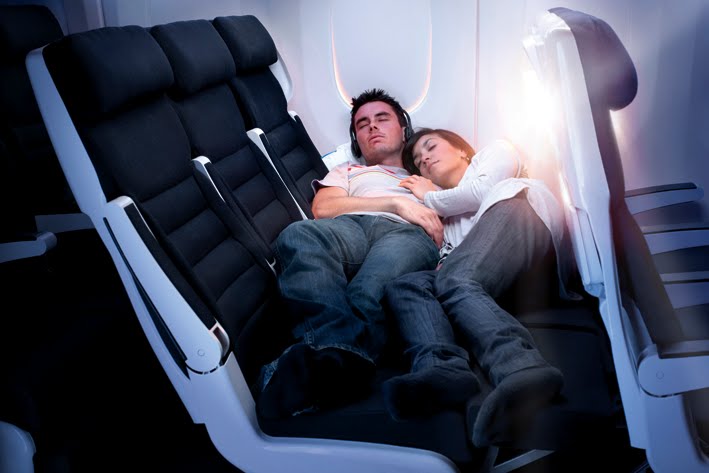
Not being satisfied with the prêt-à-porter seating offerings from Boeing and its suppliers, Air New Zealand developed a bespoke Economy Class seat and with it, the Economy Class Skycouch.


"The seats themselves are our Economy seats with armrests that disappear into the back of the seat. There’s also a cup holder, a trinket tray, a winged headrest and a sleep pillow on every seat. What makes the Skycouch different to other Economy seats is the way the trio of seats transform," Air New Zealand's website explains.


"With a touch of a button, a footrest will come out from under each of the three seats which you can pull up to create a flat, flexible space for you to use however you like."


“For those who choose, the days of sitting in economy and yearning to lie down and sleep are gone,’’ Fyfe said in a statement. “The dream is now a reality, one that you can even share with a travelling companion—just keep your clothes on.”

Air New Zealand recognized that its customers are largely leisure travelers, often on overnight long-hauls, so creating an onboard environment conducive to sleep became their highest inflight service priority. Three years on, horizontal seating hardware—to now a bragging right reserved for the plutocracy—in all three service classes has been the result of their toil.

Business Premier, Air New Zealand's business class, remains largely unchanged through the airline's service upgrades and will continue to employ the same swish seat developed and licensed by Virgin Atlantic that converts to a 6' 7.5" bed.


In its updated Premium Economy Class, a class somewhere between YMCA and country club, passengers will enjoy seats and services approaching the standards of the last decade's business classes. Arranged in pairs, the middle column of seats swivel towards one another and a shared dining table/expansive armrest. And while Premium Economy doesn't feature leg-rests, it does feature a charming beanbag chap named Otto who "would like to be an ottoman but [he] isn't quite." Otto and his clones will not even take to the air in earnest for another eight months, but Air New Zealand is already correctly conceding that they "anticipate that these will get stolen in huge numbers."

From December, 22 sets of the Skycouch will be available on Air New Zealand's flights between Auckland and Los Angeles. In 2011, Air New Zealand will introduce its new service concept in all classes on flights to London, whereafter the improvements will be introduced throughout the existing long-haul fleet, making it available to all of the airline’s Asian, North American and United Kingdom destinations by 2012.

Those that are acquainted with The Hawaiian Sybarite will be aware that we find Aotearoa continuously admirable. We find its candid-yet-intelligent informality refreshing, we find its egalitarianism and humanism reassuring and so we find it no coincidence that the first major innovation in economy class hardware since its invention is brought to us courtesy of New Zealand.


Exact pricing for the Skycouch has yet to be announced, but its intended demographics are families traveling with young children, who will be able to stretch out across the trio of seats that comprise each Skycouch, and couples who will purchase their own two seats and also the middle seat at a discount to occupy what Air New Zealand rather grostesquely refers to as its "Cuddle Class."


New Zealand's characteristic humanism was expressed by Air New Zealand's Rob Fyfe, when he identified "the pivotal point that took [Air New Zealand] in a different direction" as "the decision to be about flying people and not about flying planes."

A revolutionary concept, to judge his philosophy against the actions of his airline's competitors. Flying with an Asian airline can be pleasant enough if the social costs of Singapore Girl are ignored, and flying within Europe is often not altogether tortuous, but flying in North America is reminiscent of the worst days of Stalinism.

As for the state of aviation in our archipelagic kingdom, we at The Hawaiian Sybarite thank Mark Dunkerly for raising Hawaiian Airlines up from its bad old days to the solidly acceptable airline that it has become.

It is our advice to airline executives in Tokyo, Beijing, Seattle, Chicago, Fort Worth, Atlanta, Montréal, Copenhagen and Stockholm, Amsterdam, Frankfurt and Madrid to visit Auckland and Air New Zealand, immediately, with a pen in your pocket, your company's checkbook in your attaché and your hat in your hands. Ask thoughtful questions, take fastidious notes, and then beg Air New Zealand to license their interior hardware to your airline.

Finally, to the aforementioned list of executives one is missing and must be added—that's you, Mr. Dunkerly. We offer our sincere thanks, but praise such as "acceptable" and "better" and "not as bad as it used to be" simply isn't good enough for us. You've done well, but you've got a long way to go—3814nm to be precise.


Air New Zealand is our preferred transport to New Zealand, Australia and other points in the South Pacific. Air New Zealand now flies from Honolulu to Auckland every Wednesday and Friday evening, with Monday departures added during the airline's summer timetable. Flights to Honolulu depart Auckland on Thursday and Saturday mornings, with additional Tuesday departures this summer.

All images © Air New Zealand Limited 

Saturday, 17 April 2010

Quality of Life Improvement 6: The Waikīkī Edition, the first Edition Hotel to open from hoteliers Ian Schrager and Bill Marriott

Photo courtesy of francesjane. 

Honolulu has long been in need of a new hotelier to clear the stagnancy that has settled over O‘ahu's hospitality trade.

Ian Schrager, together with Bill Marriott, may be the hoteliers to do it.

Ian Schrager—yes, that Ian Schrager, of Club 54 fame—established the Edition Hotels & Resorts brand with J.W. Bill Marriott, Junior—yes, that Bill Marriott, of Marriott Hotels fame—to, as the Marriott website enthuses, "combine the personal, individualized and unique hotel experience that Mr. Schrager created with the operational expertise Marriott is known for."

From the foregoing explanation it should be apparent that the Edition Hotels & Resorts are not going to be in any way boutique hotels, but instead tarted-up Marriotts. That's not necessarily a bad thing.

Ian Schrager created the concept of the boutique hotel in 1984 with the opening of his Morgans Hotel in New York City. Schrager started with a derelict 1927 flop-house that happened to have excellent bones, his Morgans Hotel Group inexplicably managing to purchase the structure while also using it as collateral. He then retained the services of the venerable Parisienne interior designer Andrée Putman, without whose expertise the boutique hotel as we know it might well have never been born.

The Morgans Hotel was a tremendous success, and Schrager opened eight hotels over the following 15 years, each with French post-modernist designer Philippe Starck. The Royalton and Paramount in New York, the Delano in Miami, and the Mondrian in West Hollywood soon followed, all masterful examples of stylish packaging selling average hardware.

What Schrager hotels did possess was a sense of arrival and occasion. His hotels made people feel glamorous and sleek, and those reasons are enough for many members of his demographic to overlook poky rooms or thin walls or non-existent services.

Schrager and Starck perfected their formula of gloss and surreal yet carefully considered idiosyncrasies at a string of properties, including New York's mammoth, 1000-room Hudson Hotel. Housed in the former headquarters of PBS-affiliate WNET and with a face that only a father could love, the Hudson compensated for it's cell-like rooms with public spaces pulsing with zeitgeist. After opening the Clift Hotel in San Francisco and the Sanderson and the St. Martin's Lane Hotels, both in London, Schrager divested himself from the Morgans Hotel Group in 2005 to concentrate his energies on his Gramercy Park Hotel project in New York, crafted in close collaboration with artist Julian Schnabel and, now, the Edition Hotels venture with Marriott International.

The first property in the Edition Hotels portfolio is rumored to be opening this July, in Honolulu. While July is only slightly less than two months forward, details remain illusive, but from what our sources have told The Hawaiian Sybarite, "The Waikīkī Edition" will occupy the building that was known formerly as the ʻilikai Hotel's Yacht Harbor Tower and will offer 350 rooms.

Apart from those precious few details, Honolulu's FOX affiliate KHON 2 reported that "[o]ne part of the redevelopment involves bringing in internationally known Iron Chef Masaharu Morimoto to open Morimoto Waikiki Restaurant."

Ian Schrager's foremost talent always was, and remains, the contriving of compelling spectacles. Schrager's website credits him with the creation of "pioneering concepts" such as "the hotel as home away from home, the hotel as theater, 'cheap chic', 'lobby socializing', the indoor/outdoor lobby, the urban resort, and the urban spa."

It has been our experience of Schrager's hotels that they are very much like the fashion world's top models: fulfilling objects for idolatry and pleasant enough to look at—as long as it's remotely. But once you pay the near-extortionate price to get close enough for the satisfaction you've been conditioned to crave, you see how tawdry and threadbare and, often, just plain ugly they are without the flattering lighting and the cocophany of media hype.

Still, we'll take Schrager's overpriced and under-delivered universe of "hotel as theater" over the recent decades of the Hawaiʻi tourism-industry's stubborn commitment to mediocrity. A combination of vast overdevelopment, cruel underpricing, wrong-headed marketing, absentee American and Japanese landlords, local slothfulness and simple, vulgar greed have left Hawaiʻi resting on its laurels with an embarrassing bric-a-brac of failures of innovation in the visitor-industry.

It is the hope of The Hawaiian Sybarite that Ian Schrager will lead Marriott and its hulking, tasteless horde towards a more sensitive, more well-designed, and hopefully, more stylish future. We hope that Schrager will present alternatives to the sterile sameness of the typical Marriott property, et al, and we maintain the hope that he will introduce a concept for the Hawaiian hotel of the 21st century that doesn't rely on shameful acts of cultural prostitution or environmental degradation.

The marriage of Ian Schrager and Bill Marriott, Jr. is one whose days are seemingly numbered from the beginning. Ian Schrager is a wheeler-dealer, an æsthete, an ex-con and will forever be powdered with the excessive glamour of the late 1970s, whereas Bill Marriott is a conservative, Latter-day Saint businessman, the son of a conservative, Latter-day Saint root beer salesman. How exactly the businessman behind Studio 54 and the businessman representing the polyester of religions will pool their respective talents and synergize remains baffling to us at The Hawaiian Sybarite, but we are hoping that the opening of The Waikīkī Edition will be just the boot in the ass that all hoteliers in Hawaiʻi need in order to raise their game to a level that begins to befit our archipelago.