Showing posts with label ENTERTAINMENT. Show all posts

Monday, 22 November 2010

Quality of Life Improvement 33: Thai Kabocha-Sweet Potato Curry

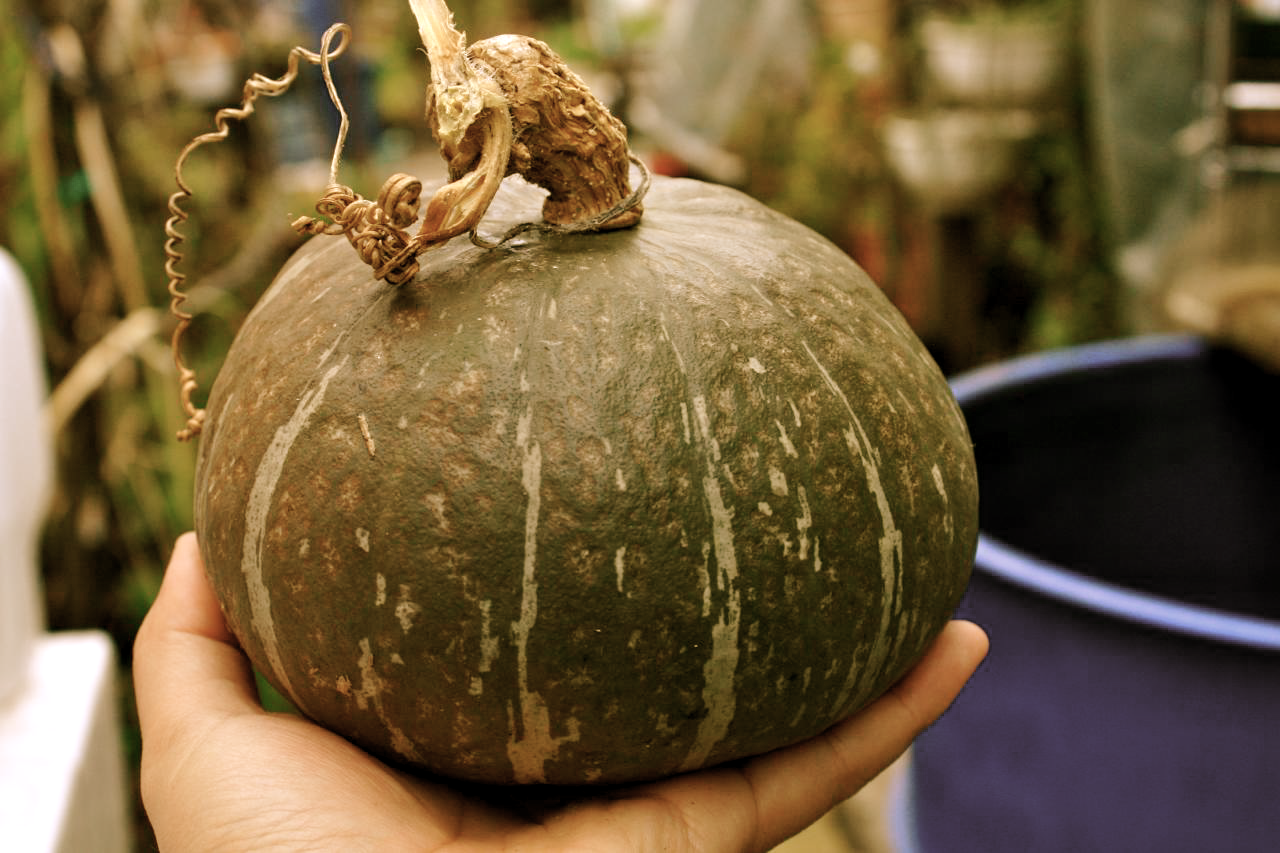
Trust us: Pure visual appeal alone is reason enough to prepare the next installment in our series of local holiday recipes. Since our education in the myriad uses of kabocha, we've been looking to use it any way we can, and for this red curry, it's æsthetically joined by Okinawan sweet potato, carrot, yellow bell pepper, Thai chili, generous amounts of Thai basil and basil flowers and (we think crucially) toasted pumpkin seeds.

At the table, adjacent to sticky rice (which always manages to defy tasteful presentation), the shades of orange and yellow are sharply contrasted with the deep purple of the sweet potato and the green of the basil. Texturally, there is a balance achieved between the comforting heaviness of pumpkin and sweet potato, offset by carrot and bell pepper, enlivened but also lightened by Thai red curry and made sweet by aromatic Thai basil, and topped with a surprisingly reasonable, crunchy addition that would've never occurred to us—pumpkin seeds.

This recipe appeals to us in so many different ways. It's autumnal and it would be perfect for persnickety, vegetarian Thanksgiving guests (like us, for instance). It's familiar comfort food, but it's also spicy and exotic. It's local and it's Thai and it's reminiscent of American Thanksgiving traditions, and we defy you to find another food that can claim all three of those descriptors.

What's more, we love this recipe because it's part of the answer to the question of the moment, to us at least: What to do with the bushel of kabocha that we have in our shed?


click to enlarge

© 2010 The Hawaiian Sybarite

Friday, 19 November 2010

Quality of Life Improvement 32: Tahitian Kabocha-Date Bread

Second in our four-part series of local holiday recipes, the following comes to you from our relatives in Tahiti. It's something like Tahiti itself: Simple enough at first glance, but upon closer inspection, nuanced, worldly, refined, elegant and a sensory pleasure.


click to enlarge

© 2010 The Hawaiian Sybarite

Tuesday, 2 November 2010

Quality of Life Improvement 31: Hawaiian Banana-Kabocha-Macadamia Bread


Kabocha (カボチャ) is one of the great culinary pleasures of autumn. For those unfortunate few who remain unacquainted, Kabocha is a smallish, versatile and surprisingly rich Japanese pumpkin.

The name Kabocha itself actually comes from a corruption of the word Cambodia, the pumpkin having arrived in Japan from that country courtesy of Portuguese sailors in 1541. Kabocha then traveled to Hawaiʻi with Japanese immigrants from the southern prefectures of Japan—mostly southern Honshū (本州) and Hiroshima, Yamaguchi, Kumamoto and Fukuoka on Kyūshū (九州), where Kabocha (かぼちゃ) was known by its alternate name, Bobora—Bobora being the Japanese adaptation of the Portuguese word for pumpkin, Abóbora.

Kabocha loves the tropics, and it's established itself across Polynesia. It's especially popular in Tonga, Tahiti and, of course, in Hawaiʻi. Until the Second World War, it was still known by it's regional Japanese name, Bobora, which was also a Hawaiian Pidgin term for a hapless, newly-arrived Japanese immigrant. From the 1950s, the pumpkin has been locally known as Kabocha, coinciding with the period when large-scale importation of Kabocha to Hawaiʻi began, mostly from the United States and Central America.


Local production is still important, however. We recently were witness to an unexpectedly lively discussion amongst local farmers about the multitudinous uses of Kabocha. We're great lovers of tenpura Kabocha, but Kabocha gelato? We had no idea. Thai Kabocha curry? A revelation. Banana-Kabocha-Macadamia bread? As it turns out, an old family favorite.

And as the first installment of a four-part series of local holiday recipes, we're sharing this recipe for Banana-Kabocha-Macadamia bread, a creation, we're told, of the Latter-day Saint colony in Lāʻie, Oʻahu.


click to enlarge

© 2010 The Hawaiian Sybarite

Friday, 18 June 2010

Quality of Life Improvement 27: The Goodnight Kiwi


Hawaiʻi desperately needs an instantly recognizable animal mascot. Humu­humu­nuku­nuku­āpuaʻa perhaps? Nēnē, or will Canada accuse us of filching their national bird? How about the Wallabies of Kalihi?

Aotearoa New Zealand has no problem with their national animal identity. At the mere mention of "kiwi" quite specific notions are top-of-mind: pathetically cute, flightless bird; outdoorsy pseudo-Englishmen; a country that not only always sits at the grown-up table but should be presiding over it permanently; and a hairy, testicle-like fruit that's green on the inside, full of vitamin-c, that nobody much likes.

Aotearoa has put this kiwi to work just about everywhere, so we hope that it has good union representation and a cracking lawyer. One of our favorite memories of Aotearoa in the 1980s is the national bird working as "The Goodnight Kiwi."

In those halcyon days before TVNZ was broadcasting what we'll charitably term "entertainment" 24/7, the broadcasting day was sweetly capped with The Goodnight Kiwi. He would turn off the last bit of programming, put on a muzak version of "Hine e Hine" and then retire to his nest at the pinnacle of the TVNZ transmitting tower, accompanied by his best friend—a curiously sized cat.

When we were young and in Aotearoa, we couldn't get enough of this. We loved thinking of the kiwi out on the horizon somewhere, sleeping under the Southern Cross; we found it all endlessly reassuring and charming. All these years later, we're still willing to suspend our disbelief that a kiwi has the manual dexterity to place a tape into a player or to operate a lift, and we can not ask ourselves why the cat is so small or why the cat isn't doing what cats famously do in Aotearoa—eat kiwis. It's just wonderful.

Hawaiʻi needs something similar. We needs more romantics. We need more verve. We need more people passionately devouring life. We need more people passionately in love with Hawaiʻi.

Tuesday, 15 June 2010

Quality of Life Improvement 25: Teenage Engineering

The Teens from Stockholm have just released a few demo videos featuring their upcoming OP-1. For those of you who don't know much about the project, please go to its website to first explore and then enjoy! For those of you who know a bit more, please feel free to skip straight to enjoy!


Sunday, 13 June 2010

Quality of Life Improvement 24: "I'm Not in Love"

"I'm Not in Love" by the English group 10cc is one of our most favorite songs, but one that sadly never seems to come up on our iPod's shuffle feature, which is a shame, because it happens to be the rarest of quantities—a unique pop song. "I'm Not in Love" is wistful, clever, romantic, forlorn and sweet simultaneously. Moreover, it expresses a genuine feeling: the cruellest labyrinthine that is the struggle to relate to the one that you're hugely in love with when you're no longer so young and when you're already set in your ways and when you have constructed an impenetrable palisade of ego-defenses.

We're dedicating this one to someone very special—you know who you are—and we hope that he enjoys it.

Tuesday, 8 June 2010

Quality of Life Improvement 22: The Joy of Sake


Hawaiʻi's King David Laʻamea Kamanakapuʻu Mahinulani Nalaiaehuokalani Lumialani Kalākaua-a-Kapaʻakea, the endearingly dissolute Merrie Monarch and last reigning king of the Kingdom of Hawaiʻi, was a true sybarite generally and, in particular, a famous appreciator of sake. In fact, when King Kalākaua arranged a dockside sumō tournament to honor the arrival of Hawaiʻi's first Japanese contract laborers on 8 February, 1885, the tournament prize was a cache of sake barrels.

We assume that the rikishi were pleased with their liquid purse, but the next day's edition of The Honolulu Advertiser wasn't particularly impressed; the article's author generously described sake as, "[a] fine beverage … not 'catlap' at least."

Sake had to be imported to Hawaiʻi until December, 1908, when Hiroshima-born Tajiro Sumida delivered the first products from his newly established Honolulu Sake Brewery. The brewery's first vintage was a disaster; Hawaiʻi's heat, humidity and sun conspired to spoil the newly-brewed sake.

But Sumida's brewery gleaned priceless lessons from their initial frustrations. The brewery introduced a major innovation to the sake industry when they refrigerated the fermentation area of their brewery—a necessity in Hawaiʻi—and the practice that was soon adopted in Japan. Hawaiʻi sake brewers introduced stainless steel equipment to the brewing-process, and were the first to use California rice in the manufacture of sake. Maybe most significantly, in 1958 Honolulu brewmaster Takao Nihei identified a mutant strain of yeast, used today throughout the sake-brewing industry, that produced far less froth in the brewing vat during fermentation, thereby increasing production yields per-vat by about one third.


With Hawaiʻi's contributions to the world of sake in mind, it is appropriate that Honolulu is home to the largest sake tasting event in the Americas: The Joy of Sake.

This year marks the tenth anniversary of the event, and for the second year it will be held at the Honolulu Academy of Arts this August 19. We're told that over 300 sakes will be offered to participants, which will be paired with tasting plates from "some of Honolulu's best restaurants."


We at The Hawaiian Sybarite especially like the detail that sake vessels made by local ceramicists from the Linekona Art Center will on offer. A classy move.

In a vulgar tone, the organizers of the event inform us gleefully that "As a special perk for Academy members, Joy of Sake will again have premium tables," before continuing to explain, in bold, that "This year, the premium tables will be cordoned off in an exclusive VIP area. This members-only benefit was a hit last year—they sold out in days."

The phrases "cordoned off in an exclusive VIP area" and "members-only" turn us off immediately and the foregoing quotations demonstrate our suspicions: that the likable concept of the event—the appreciation of an ancient cultural institution with our fellow citizens—is, to many of the event's participants, reduced to little more than an excuse for tawdry pretensions and obvious displays of wealth. Sake is mostly incidental to the affair.


What: The Joy of Sake: America's Largest Sake Celebration
When: Thursday, August 19, 2010, 6-8:30pm
Where: Honolulu Academy of Arts, 900 South Beretania Street, Honolulu, Hawaiʻi, 96814-1429 (808) 532-8700
Price: Individual: $80 per person. VIP reserved seating: $150 per person.

Sunday, 2 May 2010

Quality of Life Improvement 17: "Forever Young"


In the 1980s, "Forever Young" never appealed to us much. It was the music that our older relations liked, it was sappy and it was performed by musicians with hair that looked like proof of mental illness to us. By the 1990s, the song was long gone from our memory.

In 2006, an almost unspeakable tragedy occurred in Arctic Norway: our iPod literally froze to death in temperatures that sunk below -20°F and gave up its ghost.


On the long journey back to the Western Hemisphere we were given no choice but to listen to SAS' audio program Pure Vinyl, with ridiculous headphones (we still took them), and that's when we heard "Forever Young" consciously for the first time in 20 years.

Maybe it's aged well since 1984, when Alphaville first recorded it. Or maybe we've aged well, and from our perspective the lyrics actually make some sense, and the hair and haze of Westdeutschen Kitsch in the music video are to us sentimental and comforting now.

Laura Branigan also recorded "Forever Young" in 1985. The album for which it was recorded, "Hold Me," was a commercial failure at the time, but it was in the mid-1980s that Laura Branigan began her tradition of ending every one of her live shows with an encore of "Forever Young."

Interestingly, "Hold Me" has been out of print for many years, despite the fact that it is now considered to be one of the best albums from one of the most underrated stars of the 1980s. The album's cover artwork is unsettling, which only adds to the charm, and we have been led to believe that copies of "Hold Me" regularly sell for hundreds of dollars on eBay.

Laura Branigan will truly be forever young, to us and to everyone—she died unexpectedly of a cerebral aneurysm at her home on Long Island, New York, in 2004.

Sunday, 25 April 2010

Quality of Life Improvement 14: "As Tears Go By"

"As Tears Go By" may have been written by her future boyfriend, Mick Jagger, together with fellow Rolling Stone Keith Richards and her manager, Andrew Loog Oldham, but to us, the song will always belong to Marianne Faithfull.

Marianne Faithfull originally recorded "As Tears Go By" as a B-side in 1964 when she was 17 years old. Decca, her record company, realized that they had a major hit in "As Tears Go By" and switched the it to an A-side, and the track became hugely popular, both in the UK and the US and in so dong, made Marianne Faithfull a huge star.


In the years following "As Tears Go By," Faithfull's formerly angelic persona shifted to one more associated with her fraught and now finished relationship with Mick Jagger, the unborn child that she miscarried, the overdose and resulting coma that nearly killed her, her subsequent sordid and desperate affairs and, especially, her magnetic attraction to drugs.

Faithfull lived in London and on the streets of New York in the late 1970s, addicted to cocaine and heroin, with her career and personal lives in shambles.

The years of drugs and chronic, untreated laryngitis had, as one journalist wrote at the time, "permanently vulgarized her voice." The once-pure, almost fragile, high soprano had cracked and fallen two octaves into that rarest of female vocal quantities—a genuine contralto.

In 1979, still in the depths of opiate addiction, Faithfull released "Broken English." The listening public hadn't heard from Marianne Faithfull in a decade, and when the album started to spin, the voice knocking at their eardrums was dark, deepened, ragged and altogether different than the wistful innocence of Marianne Faithfull, ca. 1964. What's more, the ablum's lyrics stood in extraordinary contrast to that contained in her previous recordings—explicit tales of infidelity, oral sex, terrorism, aging female angst—which scandalized and polarized public opinion.


However, the album was a supreme critical success and is considered one of the greatest of all time, and certainly the greatest of her career; Faithfull herself simply describes it as "the masterpiece."

A version of "As Tears Go By" was recorded for the 1987 album "Strange Weather," and the dissonance between the voice of 1965's Marianne Faithfull and the Marianne Faithfull of 22 years later shifted the tone of the song from cool longing to world-weary wisdom.


Just last year, Faithfull appeared on an installment of the BBC4 Sessions program with the realease of her latest album "Easy Come, Easy Go." For the first time since the 1960s, she sang "As Tears Go By" to it's full, original arrangement.


Marianne Faithfull's albums are available from iTunes, and are available in both mp3 and CD format from amazon.com.

Additional stockists include:

Barnes & Noble Booksellers Ala Moana Mall, 1450 Ala Moana Blvd. Suite 1272, Honolulu Hawaiʻi, (808) 949-7307.

Tuesday, 20 April 2010

Quality of Life Improvement 8: Hitachino Nest Beer


Arne Jacobsen, architect and one of the godfathers of Danish-Modernism, was asked about the formation of his philosophy of æsthetics.

"A pastry usually tastes better if it looks nice," he said. "A cream pastry, now that looks nice—in fact, there is nothing I mind as long as it looks nice."

We at The Hawaiian Sybarite live by these sage words, and we fall hard for beautifully-designed packaging. Rarely is it that we see packaging as nice looking as the Hitachino Nest line of beers. We were entirely ready to enjoy Hitachino Nest solely for the novelty of its packaging, but were surprised by the quality of its contents. This is excellent beer.


Kiuchi Brewery (木内酒造) of Naka, Japan, began brewing Hitachino Nest Beer in 1996. Kiuchi's history stretches back to 1823, when the company was founded to produce sake and shōchū (焼酎). In the 1990s, Kiuchi struck upon the rather clever idea of using the techniques and implements—and even ingredients—for the manufacture of sake and shōchū in the brewing of beer, thus hatching Hitachino Nest Beer.

The Hitachino Nest Beers are top-fermented ales and, at the time of writing, are brewed in no less than 13 varieties: Amber Ale, Espresso Stout, Ginger Ale (and another version that Kiuchi curiously refers to as "Real Ginger Ale"), Japanese Classic Ale, New Year Celebration Ale, Pale Ale, Red Rice Ale, Sweet Stout, Weizen, White Ale, and XH, a Belgian Strong Ale that matures for three months in shōchū casks.

Hitachino Nest's White Ale is a Belgian-style witbier, surprisingly creamy and deeply spicy. Kiuchi has strongly-spiced theier White Ale with clove and coriander, and, in the tradition of Belgian witibers, there are strong suggestions of citrus. The clove lingers after you've enjoyed the last of this beer, and there's little sweetness to it, which makes it an ideal pairing with Japanese food.

New Year Celebration Ale seems to us at The Hawaiian Sybarite to be an obvious descendant of the Scandinavian breweries' tradition of releasing special Christmas- and New Year's-beers. Like its Nordic antecedents, Hitachino Nest's Celebration Ale is sweeter and spicier than traditional beers, with aromas originally drawn from Gløgg, the season's mulled red wine.

Kiuchi's Celebration Ale has all the requisite ingredients in well-crafted harmony: cinnamon, citrus, plenty of coriander, nutmeg and vanilla. The ale itself is eminently enjoyable, but we encourage you to take note of the bottle and its labeling; we think that it's the most arresting packaging we've encountered, with a representation of Fuji-san reminiscent of Hokusai and our favorite owl friend front-and-center flying dangerously close to cute overload territory but ultimately winging away from the precipice.

The Red Rice Ale pours guava-hued with a head both tinted and scented strawberry, courtesy of this beer's eponymous ingredient. It is surprisingly sweet and also surprisingly sake-like, owing its fermentation by sake-yeast and its 7% alcohol-by-volume content—give us the keys to your car now and let Kiuchi Brewery—their owl—take you on a journey.

The Hitachino Nest Red Rice Ale is rumored to be the last Red Rice beer in the world, and if you like your beer boozy, exotic, fruity, malty and subtly-complex, drink up. After all, the owl always was the wisest of all birds.


Hitachino Nest Beers are available at Whole Foods Market, 4211 Waialae Avenue, Honolulu Hawai‘i, 96816-5340, (808) 738-0820.

For additional stockists, consult Kiuchi Brewery or, in the United States, B. United International Inc.

Saturday, 17 April 2010

Quality of Life Improvement 5: "Wave" by Antônio Carlos Jobim


We at The Hawaiian Sybarite find much to admire in Antônio Carlos Jobim—Tom Jobim to us. We admire him for essentially creating bossa nova, together with João Gilberto and Vinicius de Moraes in Rio de Janeiro in six short years from 1958, the year when everything happened, as far as we're concerned. We admire him for leaving us with a songbook of jazz standards that includes "A Felicidade," "Agua de Beber," "Corcovado," "Desafinado," "One Note Samba," "Wave," and his valentine to Cariocas, "The Girl from Ipanema."

Above all else, we admire him for being a romantic.

"My work is all a song of love to Brazil, my land, people, flora and fauna—from the sight of my window or the window of the airplane."


Jobim studied architecture and even worked in an architect's office, but quickly realized that he'd much rather be spending his days playing the piano than sweeping eraser dust from his drafting table. A life of quiet fulfillment through rationality wasn't for him. (As an aside, we at The Hawaiian Sybarite have found ourselves in the same situation—except that we can't read music—and Jobim's life gives us hope that we may one day be called to the greatness that awaits us.) 

Jobim began his career as a professional musician by performing in bars and clubs during the early 1950's in Copacabana. It was in these bars that his unique talent as a musician was recognized and he was signed to a record company where he was first employed to arrange other artists' work. Gradually he became a more active composer, performer and recording-artist, and the result was bossa nova.

When speaking of the outstanding albums of Tom Jobim's catalogue, we're embarrassed for choice, but 1967's "Wave" is our personal favorite.

"Wave" is much too short at just over 30 minutes. Not that the album doesn't contain track after track of masterful tone-poems, we'd simply like the album to continue indefinitely. If there was ever a soundtrack for the days when a black cloud is stationed over your head, this is it.

An album to be savored in its entirety, we suggest listening to it while relaxing supine at sunset with a caipirinha close at hand. While doing so, keep an ear open for title track "Wave," as well as "Batidinha," and "Triste."

"Wave" seizes the relaxed joy of Brazil but just underneath the surface, it also captures the wistful recognition that this world can be a dark place, and there may be a light some place, but you don't know where. 

What makes the Brazilian personality and particularly the outlook of Cariocas so admirable is their seemingly effortless ability to both recognize their own suffering and then choose to forget it. There may be potentially terminal catastrophes. The planet is in peril. There is exploitation and sadism and abuse and indifference, but Brazilians are going to carry on having a good time in spite of the misery around them.

Those from the sober north may often consider this philosophy at best Dionysian and at worst, infantile and superficial. In his inimitable manner, Jobim answered that criticism.

"This is a country that prostitutes enjoy, where the dealers snort and where a used car is worth more than a new car. Is this or is this not a country standing on its head? Brazil is standing on its head, and if you say it's standing on its head, then put your head upside down, you see that it's head up."


"Wave" is available from iTunes, and is available in both mp3 and CD format from amazon.com, but for the most authentic experience, we at The Hawaiian Sybarite highly recommend the vinyl release of "Wave," also availble from amazon.com.

Additional stockists include:

Barnes & Noble Booksellers Ala Moana Mall, 1450 Ala Moana Blvd. Suite 1272, Honolulu Hawaiʻi, (808) 949-7307

Wednesday, 14 April 2010

Quality of Life Improvement 3: Monoi—the fountain of youth does, in fact, exist in « la Nouvelle Cythère »

Monoi is reputed to mean "sacred oil" in reo-Tahiti, the Tahitian language. While there are no linguists here, we can write with confidence on the qualities of the product itself; Monoi smells heavenly.


Created from the Tiare (Gardenia Taitensis), the national flower of Tahiti where it grows in luxuriant profusion, and Copra oil, Monoi was previously reserved solely for the chiefly class, the Ari‘i. Now, the term "Monoi oil" is a protected Appellation of Origin which requires Monoi to be manufactured in Tahiti of Tahitian materials under strict, specific conditions. The involved production of Monoi requires that at least 15 unopened Tiare flowers be mascerated in each liter of refined Copra oil for a period of at least 15 days.

Monoi has the mysterious ability to reduce the signs of aging—something about stimulating collagen production and improving microcirculation through hydration, we've been told. Whatever the reason, it works. 

When Captain James Cook arrived in Tahiti, he observed Tahitians using the oil in myriad circumstances, both sacred and profane.

Monoi was used to lubricate the skin of newborns and to prepare the bodies of the recently deceased for their transit to the afterlife. Tahitians carried Monoi in their vaa (outrigger canoes) on their jaunts to Hawai‘i and Aotearoa so that their mariners could protect their skin from the elements and dehydration; divers used it for the same reason, and still do.

To the original Monoi formula has been added new ingredients, including: flowers Pitate (Pīkake/Arabian Jasmine), Santal (Sandalwood) and Tipanie (Plumeria/Frangipani); sunscreen/UV filters; and iodine (to accentuate the appearance of a suntan).

Our advice? We're traditionalists and so we are partial to the original Monoi formula, but if you prefer a subtly exotic yet more discreet and masculine fragrance, we suggest Monoi Santal. If you must try something different, both Tipanie and Pitate are mostly inoffensive, but in our opinion they're no improvement over the classic Monoi.

Avoid Monoi Rouge with iodine as well as Monoi products with an SPF factor and use a proper sunscreen instead. If you happen to burn, Monoi will help to relieve the pain and heal the skin. And speaking of pain, cosmetics company Nars is marketing an attractive 4 oz. bottle of classic Monoi—for over seven times the price of its Tahitian import siblings.

We should also suggest passing-over Monoi Coco (Coconut). While not offensive, it is a gourmand scent, which is the problem. If you do choose to slather Monoi Coco over your nubile flesh don't be surprised if a bartender adds crushed ice, a pineapple wedge and a cocktail parasol to your décolleté, since you'll smell oddly similar to a Piña Colada.


Monoï Tiki Tahiti brand Monoi Oils ($7.59) are available at Longs Drug Store, Ala Moana Center, 1450 Ala Moana Boulevard, Honolulu Hawai‘i, (808) 941-4433.

Additional stockists include:

Whole Foods Market, 4211 Waialae Avenue, Honolulu Hawai‘i, 96816-5340, (808) 738-0820
Monoi Tiare Tahiti

Tuesday, 13 April 2010

Quality of Life Improvement 1: "Highway Rider" by Brad Mehldau


Still indebted to Bill Evans, 2010 finds Brad Mehldau collaborating with pop producer Jon Brion to create the ambitious, and mostly successful, classical-jazz "Highway Rider" two-disc epic. 

In his prodigious previous recordings, Brad Mehldau, both with and without his trio, has ricocheted from California-style, Cool-Jazz interpretations of the Beatles' catalogue, jazz takes on tracks from Radiohead ("Everything in its Right Place" being a stand-out example) to collaborations with soprano vocalist (Renée Fleming on "Love Sublime" in 2006) and Pat Metheney (on the album "Quartet" in 2007).


"Highway Rider" presents the listener with 15 original compositions, stretching over 100 minutes of aural landscapes that Mehldau alone arranged and orchestrated. He is joined by, among others, drummer and frequent Tori Amos collaborator, Matt Chamberlain and saxophonist Joshua Redman.

This album is perfect at home, at sunset. It's music to relax and to savor. The Hawaiian Sybarite recommends the tracks "Walking the Peak," "We'll Cross the River Together," as well as the title track, "Highway Rider" for heavy rotation on your iPod.


"Highway Rider" is available from Nonesuch Records, on iTunes or from Amazon.com.